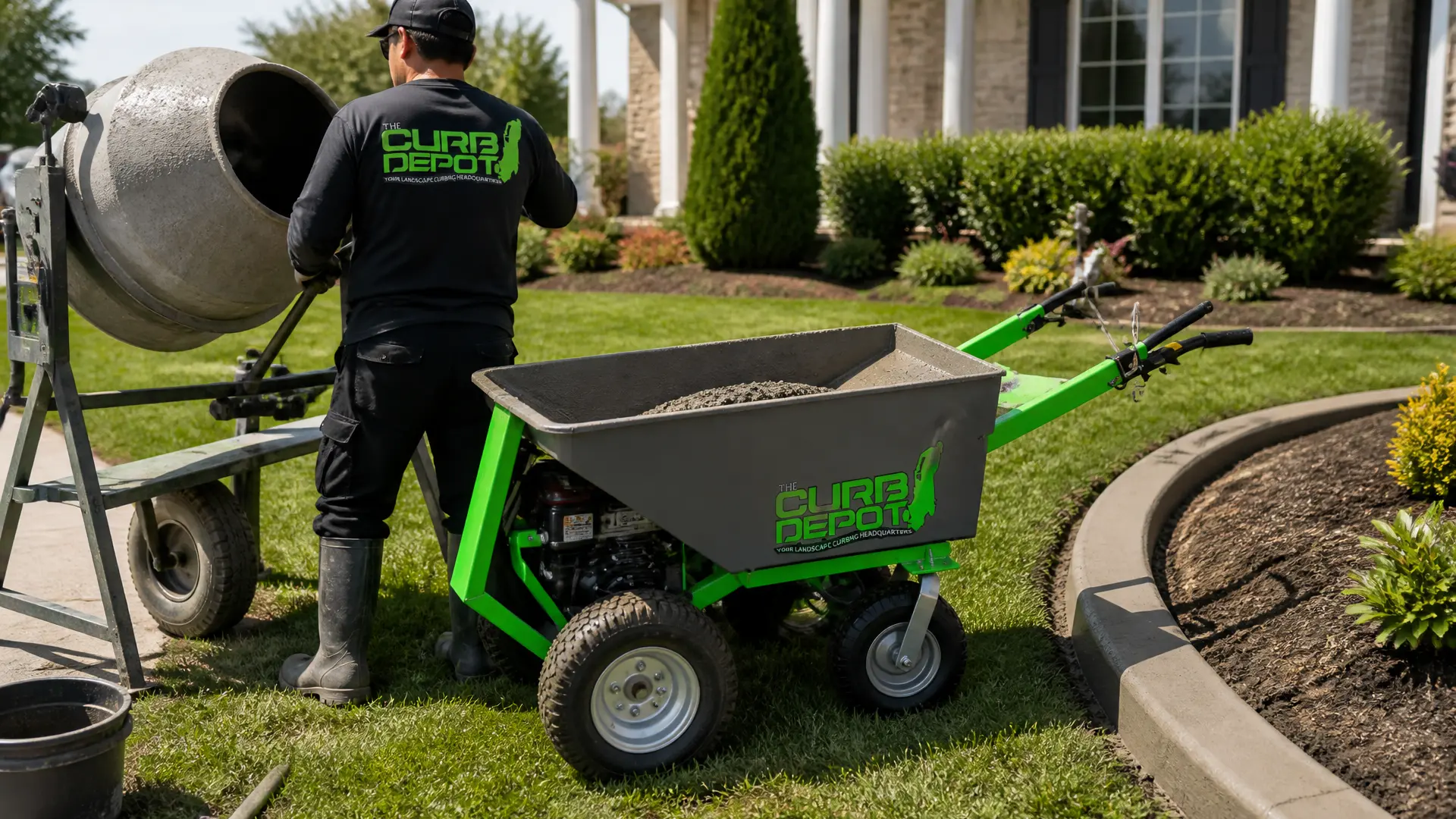
Moving concrete and mortar from the mixer to the curb machine is one of the most repeated trips on a curbing job, and the wheelbarrow used for that trip affects more than comfort. The right choice between a manual and a powered model comes down to the actual route a crew covers, how the load is controlled, and how material gets unloaded at the machine, not just which wheelbarrow looks like it carries more.
Curb Depot offers the Legends Power Wheelbarrow with Hydraulic Brake alongside the Harpten curb machine, Whiteman 7- and 9-cubic-foot concrete and mortar mixers, and curbing trailers, so a crew can plan its material transport and placement equipment together rather than buying a wheelbarrow in isolation.
Judge the Route Before the Wheelbarrow
Before comparing specs, look at the ground a loaded wheelbarrow actually has to cross.
A short, flat, paved path between the mixer and curb machine puts far less physical strain on a crew than a long run across loose soil, uneven ground, or a sloped yard. Crews regularly facing hills, rough ground, or repeated long hauls may benefit from powered assistance. Crews working short, level routes may find that a manual wheelbarrow meets their needs without the added cost or maintenance of an engine.
Also consider how often the route changes as the curb machine advances. A wheelbarrow needs to work not only along the initial route but also around landscaping, gates, and other obstacles encountered throughout the job.
Tub Size Is Not the Same as Load Capacity
It is easy to assume a powered wheelbarrow automatically holds more material than a manual one, but that is not necessarily true.
Tub capacity measures how much space is available for material, usually in cubic feet. Rated payload measures how much weight the equipment is designed to carry. These are separate specifications, and the weight limit can be reached before the tub is completely full, particularly when transporting dense materials such as concrete.
A motor changes how the load travels, not necessarily how much material the wheelbarrow is rated to hold.
When comparing models, check both the published tub volume and the rated payload. If a manufacturer does not provide both figures, request confirmation before using the equipment for a particular concrete or mortar load.
Powered Travel and Powered Unloading Are Two Different Features
A motorized wheelbarrow reduces the effort needed to move material across a jobsite, but that does not automatically mean the dumping mechanism is powered too.
Some powered wheelbarrows use conventional handle-operated tipping, while other models incorporate hydraulically assisted dumping. The difference matters when crews repeatedly empty dense mixes at the curb machine.
When comparing powered models, ask whether the unit only motorizes travel or also assists with unloading.
It is especially important not to confuse a hydraulic braking system with hydraulic tipping. A wheelbarrow can have hydraulic brakes without having a hydraulically powered dumping mechanism.
What the Legends Power Wheelbarrow Brings to a Curbing Crew
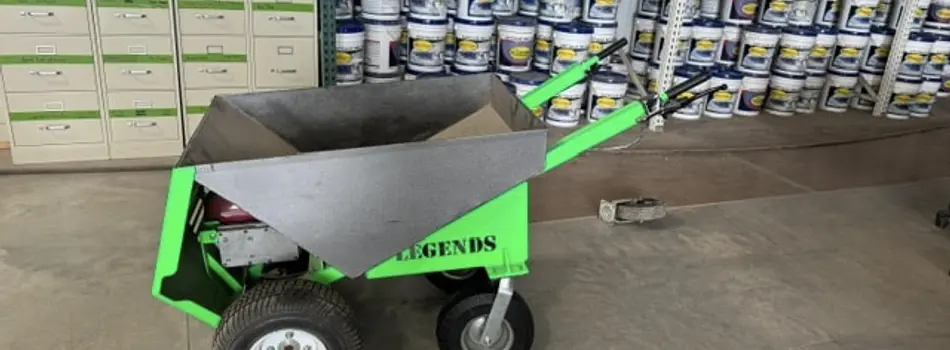
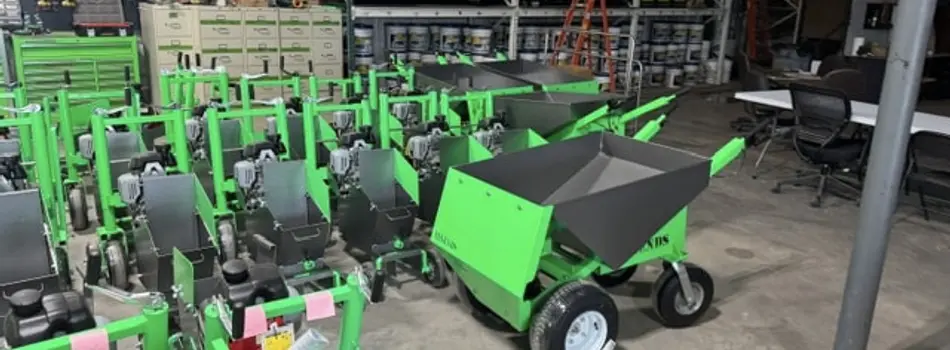
Curb Depot’s Legends Power Wheelbarrow with Hydraulic Brake features a four-cycle Honda GX50 engine and an adjustable chain-tensioning assembly.
Its published features include:
- A locking hydraulic disc brake
- Independent rear rubber casters and large front turf tires
- A balanced center of gravity designed to make dumping easier
- A wide stance for stability
- A dry weight of 254 pounds
- Dimensions of 66 inches long, 28.5 inches wide, and 32 inches high
These dimensions and the machine’s weight matter for storage, trailer loading, and getting the unit through gates or narrow side yards. They are worth checking against the routes and equipment access points a crew regularly encounters.
Curb Depot describes the Legends model as having a balanced design for easier dumping, but its published product description does not specify hydraulic tipping. Crews that need powered unloading should confirm that feature before ordering rather than assuming it is included because the wheelbarrow has hydraulic brakes.
Braking and Control Deserve a Close Look
Powered wheelbarrows introduce considerations beyond those of a manual model, including engine operation, drivetrain control, braking, and machine weight.
The Legends Power Wheelbarrow includes a locking hydraulic disc brake, which is an important feature to review when evaluating how the machine will be secured and controlled during operation.
However, different powered models can use different braking and drive systems. Do not assume every machine has the same downhill control, parking-brake behavior, or freewheeling capabilities.
Before operating a powered wheelbarrow, review the manufacturer’s instructions for safe loading, braking, maneuvering on slopes, and unloading. The rated capacity, ground conditions, and operating procedures should determine how the unit is used.
Receiving Discharge at the Mixer
The other half of the transport question is how material gets into the wheelbarrow in the first place.
Mixer discharge height, wheelbarrow tub height, and receiving clearance all influence how efficiently a crew can transfer concrete or mortar from the mixer.
A wheelbarrow that works well on the transport route may still be inconvenient if its tub cannot be positioned properly beneath the mixer’s discharge opening. Likewise, trailer-mounted mixers and standalone mixers may create different loading conditions.
Before choosing a wheelbarrow, compare its dimensions with the specific mixer configuration your crew uses.
Curb Depot offers Whiteman concrete and mortar mixers in 7- and 9-cubic-foot sizes. Confirming the mixer and wheelbarrow configuration together helps avoid equipment compatibility problems after purchase.
Weighing Ownership Beyond the Purchase
A manual wheelbarrow typically costs less to acquire than a powered one, which is a real advantage for crews that do not need motorized assistance.
A powered unit adds engine upkeep, drivetrain components, and braking-system maintenance. The Legends model also includes a chain-tensioning assembly that should be maintained according to the manufacturer’s instructions.
Curb Depot lists replacement components such as wheelbarrow handle grips, the Legends power-wheelbarrow on/off switch, and its brake lever among its available equipment parts.
| Factor | Manual Wheelbarrow | Powered Wheelbarrow |
|---|---|---|
| Upfront cost | Typically lower | Typically higher |
| Best fit | Short, flat routes | Rougher terrain, slopes, and repeated longer hauls when conditions permit |
| Unloading effort | Typically manual | Depends on model; powered travel does not guarantee hydraulic dumping |
| Ongoing maintenance | Wheels, handles, tub, and other basic components | Engine or motor, drivetrain, brakes, and additional mechanical components |
| Jobsite considerations | Load weight and operator effort | Load weight, control system, machine weight, terrain, and access |
The right choice depends on whether the benefits of powered transport justify the added purchase cost and maintenance for your crew’s typical workload.
If You’re Already Planning a Package
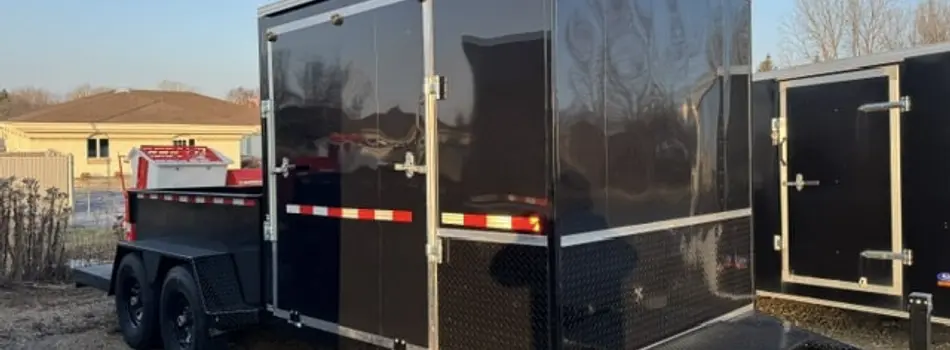
Curb Depot’s current Business Pro package includes a wheelbarrow alongside a 23-foot curbing trailer, a concrete mixer, a trailer mixer mount, a Harpten curb machine, and training.
However, the published package lists a wheelbarrow generically rather than identifying a particular manual or powered model.
If powered transport matters to your crew, confirm which wheelbarrow is included in the package before ordering. Curb Depot also offers package customization, so you can discuss whether the Legends Power Wheelbarrow is an appropriate addition or alternative.
Pairing the wheelbarrow with the right concrete mixer and curbing trailer keeps the entire mixer-to-machine workflow in mind.
You can review the available equipment configurations on Curb Depot’s Curbing Packages Overview page.
Ready to Compare Equipment for Your Crew?
Curb Depot is based in Appleton, Wisconsin, and works with landscape curbing professionals in the Fox Valley and beyond.
Whether you’re comparing manual transport with powered assistance, evaluating the Legends Power Wheelbarrow, or planning a complete curbing equipment package, the best starting point is your crew’s actual route, material load, access requirements, and budget.
Call Curb Depot at (920) 740-2218 to discuss your equipment needs and determine which setup makes sense for your operation.
Earn More With Natural Stone.

Click to Register

Create beautiful curb with unique stamps.

Looking to sell your equipment?
Let us help.