
What a Control Joint Actually Does
A control joint, sometimes called a contraction joint, is a planned weakened plane. It does not stop concrete from shrinking or reacting to temperature change. It guides that movement into a straight groove instead of letting it crack randomly across the surface, as outlined in the National Ready Mixed Concrete Association’s guidance on joints in concrete.
It’s worth being precise with terminology here, since it’s easy to mix up. A control or contraction joint controls where shrinkage cracking happens. An expansion or isolation joint is a different thing entirely, used where concrete needs room to move independently next to a wall, slab, or another concrete element. If a product is labeled for cutting expansion joints, that doesn’t change what the groove is actually doing in a curbing application, so don’t let the label confuse the purpose.
When to Cut Joints in Fresh Extruded Curbing
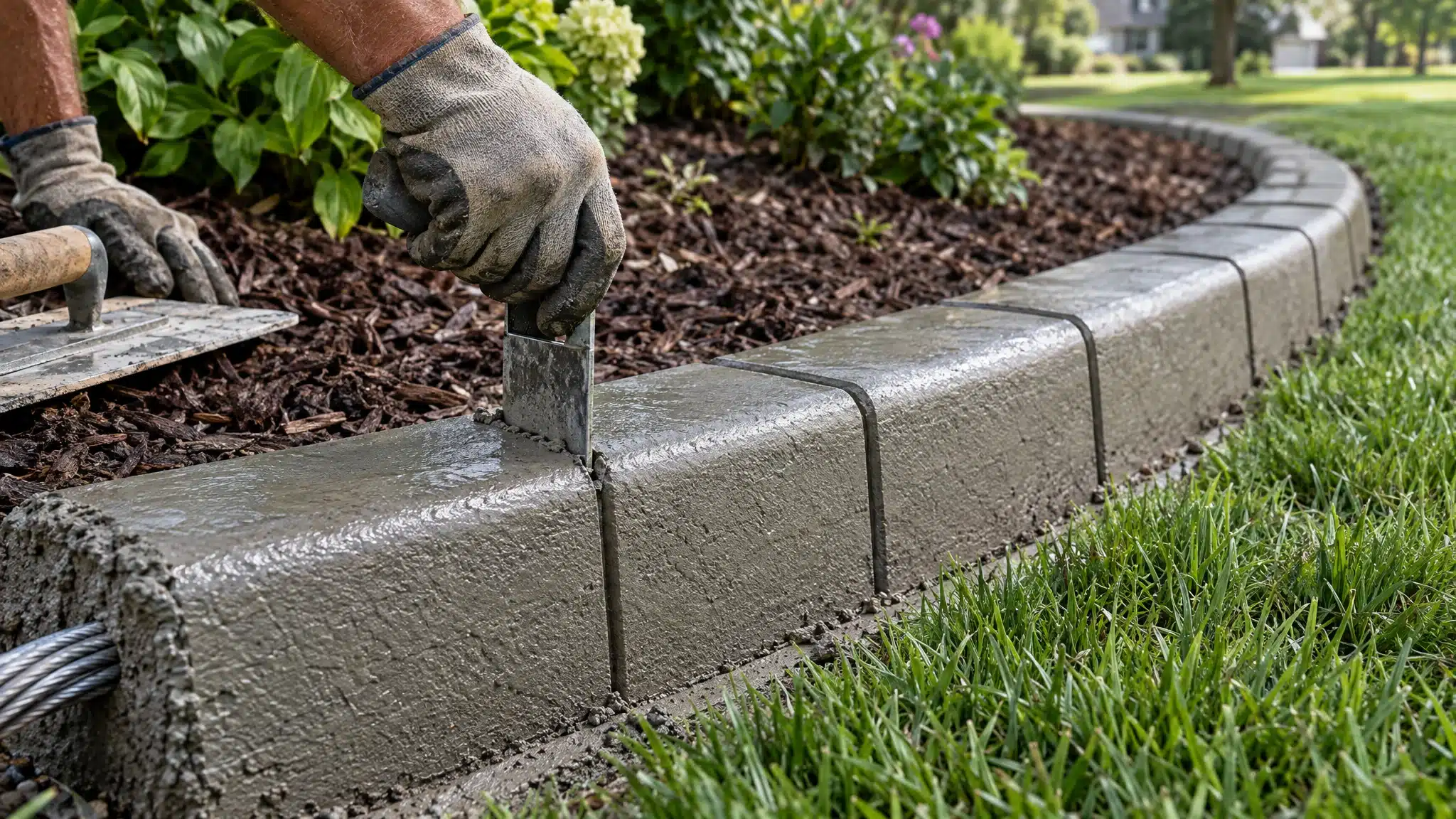
Timing is the part most contractors get wrong, in either direction. For extruded landscape curbing, joints go in after the shape has been extruded, after troweling or finishing, and after any roller-applied texture, but while the concrete is still fresh enough to tool cleanly. Cut too early and the groove can tear or drag. Wait too long and the curb may crack on its own before the joint is in place. Curb Depot’s own guide to using a curbing machine walks through this sequence from extrusion through finishing and cleanup.
Some contractors saw-cut joints instead of hand-tooling them. If you go that route, the same timing sensitivity applies: cutting too early can ravel the edges of the cut, and cutting too late defeats the purpose since the curb may have already cracked on its own.
Joint Depth and Choosing a Tool
As a practical rule, a control-joint groove should run at least one-quarter of the curb’s total depth. That proportion shows up consistently in general concrete guidance for slabs as well, even though extruded curbing is a different application. Going shallower than that gives the crack an easy path to wander outside the groove instead of following it.
A purpose-made joint tool makes this easier to execute consistently than improvising with whatever is on the truck. Curb Depot’s Cut Joint Tool is sized for cutting these joints into fresh curbing.
Spacing Is a Project Decision, Not a Fixed Number
There isn’t one spacing figure that works for every job. Spacing should respond to curb depth, mix design, decorative texture, and the geometry of the run itself. Curves, corners, and texture transitions all change how and where shrinkage stress concentrates, so joints often need to be placed closer together around those features rather than at a uniform interval down a straight run. Because the right spacing depends on these project-specific factors, treat it as a decision to make on site for each job rather than applying one memorized number to every curb.
What Still Affects Cracking After the Joint Is Cut
Jointing is one part of crack control, not the whole picture. A few other factors matter just as much:
- Mix water and weather: Excess water increases shrinkage as it evaporates, and hot, windy conditions accelerate surface drying. Plastic-shrinkage cracking is most likely during the first 24 to 48 hours, so protecting fresh curbing from rapid moisture loss in that window matters as much as where the joints are cut.
- Mix workability: Curb Depot’s Assurance Admixture is designed for low-slump curbing mixes and is formulated to improve workability while helping reduce shrinkage, cracking risk, and efflorescence. It supports a better mix, it isn’t a substitute for correct joint placement.
- Base preparation: A poorly compacted or unstable base can cause ground movement and settlement that lead to cracking later on, and no amount of correct jointing will fix a crack caused by a moving base.
- Reinforcement: Curb Depot supplies galvanized and stainless steel cable for curb reinforcement. Cable helps keep a cracked section aligned if cracking occurs, but it doesn’t decide where that crack happens. That’s the joint’s job, so reinforcement and jointing work together rather than replacing one another.
For more on how mix consistency ties into this, see Curb Depot’s guide on mixing concrete for curbing, and for a broader look at crack causes and prevention, see why concrete curbing cracks and how to prevent it.
Frequently Asked Questions
What is the difference between a control joint and an expansion joint in landscape curbing?
A control joint (also called a contraction joint) guides where shrinkage cracking happens. An expansion or isolation joint serves a different purpose, giving concrete room to move independently next to another element. Don’t assume a tool or product labeled for one does the job of the other.
Can steel cable reinforcement replace control joints in concrete curbing?
No. Cable reinforcement helps keep a cracked section aligned after cracking occurs. Control joints are what determine where the crack happens in the first place. They address different problems and work best used together.
What should a contractor do if the curb starts tearing or crumbling while jointing?
Tearing or crumbling while jointing usually means the concrete is too soft or too wet to tool cleanly yet. Wait a little longer until the surface holds a clean groove, and make sure any decorative texture work is fully finished before cutting so the tool isn’t dragging through texture that hasn’t set.
Get the Tools and Training to Do It Right
Curb Depot supplies the joint tools, the Assurance Admixture, and the steel cable reinforcement used across this process, along with hands-on training for contractors who want to see proper jointing technique in person rather than working it out on a job site. If you have questions about joint tools, mix workability, or reinforcement options for an upcoming curbing project, call Curb Depot at (920) 740-2218. Curb Depot is based in Appleton, WI and supports curbing contractors and entrepreneurs throughout the Fox Valley, including Neenah, Menasha, and Kaukauna.
Earn More With Natural Stone.

Click to Register

Create beautiful curb with unique stamps.
Looking to sell your equipment?
Let us help.



Ready to Order Your New Curbing Trailer? Request More Info.
Give us a call at (920) 740-2218 or simply fill out the form below to learn more about getting all the tools and training to get started. We make the process easy to start earning money in landscape curbing.