
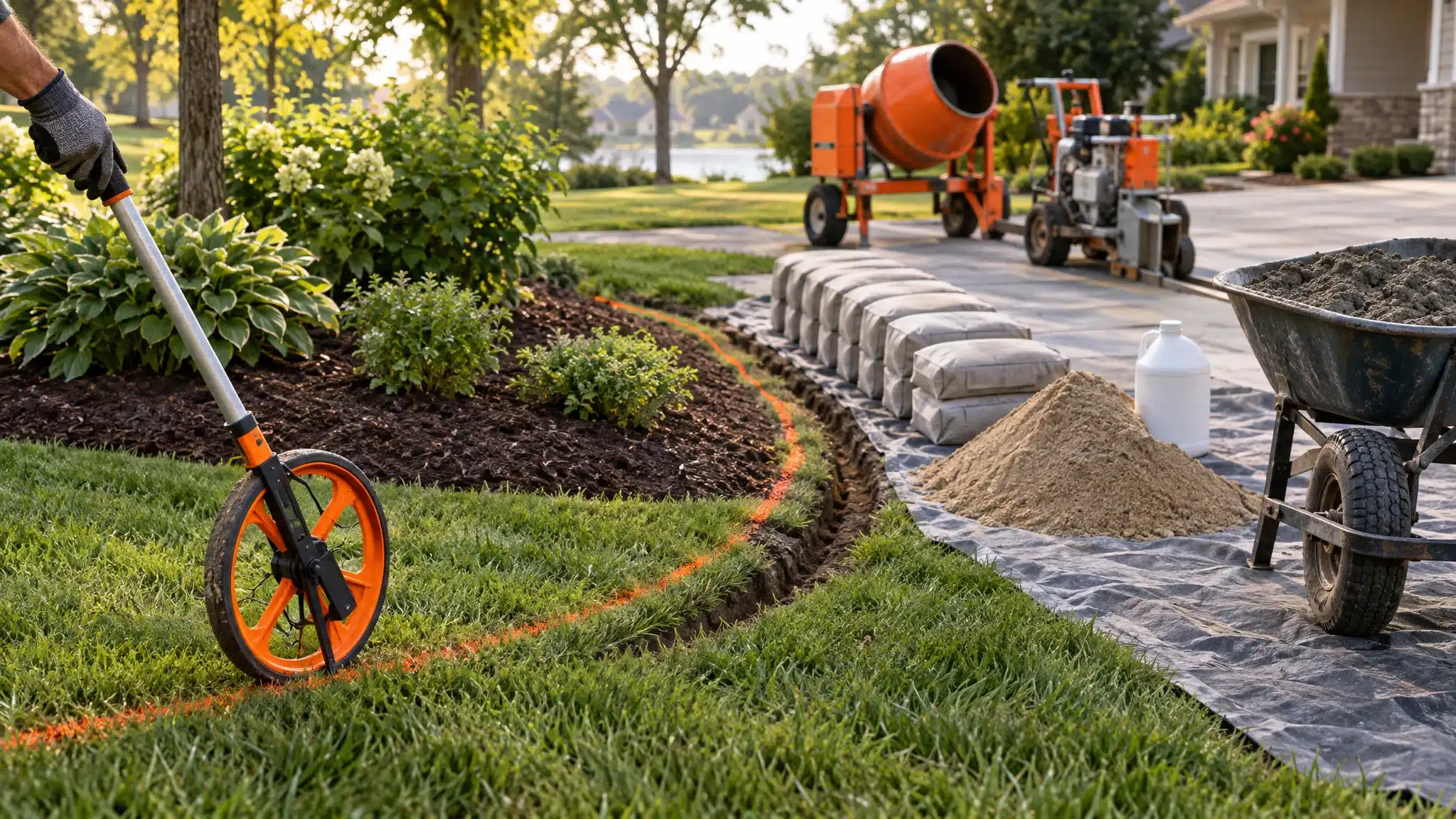
Calculate Volume From the Profile, Not the Linear Footage
The most reliable way to estimate material is to start with the cross-sectional area of the mold a crew plans to run, then apply that area across the planned footage. For a rectangular approximation, the math works like this:
- Measure the mold’s width and height in inches.
- Multiply width by height to get the cross-sectional area in square inches.
- Multiply that area by the planned run length in feet.
- Divide the result by 1,728 to convert to cubic feet.
This gives a transparent, reusable calculation instead of relying on a one-size-fits-all bags-per-foot estimate that does not account for the profile actually being poured.
Shaped Profiles Are Not Full Rectangles
A rectangular approximation works as a starting point, but it is important not to treat mold dimensions as automatically equal to concrete volume. Slant, mower, and other shaped profiles have less concrete cross-section than a full rectangle with the same outside width and height. This is the main reason a generic linear-foot estimate can overstate material needs.
Curb Depot offers Harpten profiles along with slant, square, mower, and heavy-duty molds, plus compatible EdgeMaster and Kwik Kerb options. Before running the calculation, measure the actual profile that will be used on the job rather than assuming a standard shape, since profile selection changes both material demand and finished yield.
Keep the Mix in the Right Range
A volume calculation is only useful if the batch itself is suitable for extrusion. Landscape curbing requires a zero- or low-slump mix that holds its shape immediately after leaving the mold. A typical curbing mix uses roughly 1 part Portland cement to 2 to 2.5 parts sand or fine aggregate, with minimal water and no coarse gravel. For full mixing ratios and batching detail, see how to mix concrete for curbing.
Water control matters as much as the math:
| Mix Condition | What Happens |
|---|---|
| Too much water | The curb can slump, lose its shape, and become more prone to cracking |
| Too stiff or dry | The mix can stall the plunger, leave voids, or crumble instead of extruding cleanly |
If a batch does not seem to go as far as expected, adding water to stretch it creates production and quality problems rather than solving the estimate. A compatible low-slump admixture is a better way to address workability. Assurance, for example, is a neutral, biodegradable lubricating liquid additive built for low-slump concrete. Curb Depot describes it as improving workability and easier placement and extrusion while reducing shrinkage, cracking risk, and efflorescence formation. Learn more about this low-slump curbing admixture.
Verify the Math With a Trial Batch
A theoretical calculation is a starting point, not a final number. Before committing to the full material plan, run a trial batch and observe how it fills the mold, how the machine extrudes it, and how many linear feet it actually produces. Actual output can differ from the calculated estimate because profile geometry, loading loss, corners, cleanup, and mix moisture all affect consumption. Use that measured yield, not the theoretical number, to plan the rest of the job’s batches.
Keeping the hopper supplied matters here too. Letting it run empty during extrusion can create gaps or weak spots in the curb even when the mix itself is correct, so material planning should account for production flow and not just total purchase volume. See more on how a curbing extruder moves concrete through the mold.
Turning Total Volume Into Batches
Once the job’s total cubic footage is known and confirmed against a trial batch, it can be translated into planned mixer loads based on a crew’s verified usable batch capacity. Curb Depot carries Whiteman 7 cubic foot and 9 cubic foot concrete and mortar mixers, which can be factored into batch planning once a crew knows how much usable volume a mixer actually delivers per load. Browse available concrete and mortar mixers for curbing crews.
Frequently Asked Questions
How do I calculate cubic feet of concrete for a curved landscape border?
Measure the curved run’s length the same way as a straight run, then apply the profile’s cross-sectional area across that length using the same width times height times run length formula, divided by 1,728. Confirm the result with a trial batch since corners and curves can affect material consumption.
Why does the same batch produce different linear footage on different curbing profiles?
Each profile has a different cross-sectional area. A slant or mower mold uses less concrete per linear foot than a full rectangular profile of the same outside dimensions, so the same batch volume will stretch further on a smaller-cross-section profile.
Should I add more water if a curbing batch does not seem to go far enough?
No. Adding water can cause the curb to slump, lose its shape, and crack more easily. If a batch needs better workability, a compatible low-slump admixture is the better option, and the volume estimate itself should be rechecked against a trial batch.
Plan Your Next Pour With the Right Equipment
Getting the material calculation right starts with having the right profiles, mixers, and admixtures on hand. Curb Depot supplies curbing machines, molds, mixers, and low-slump admixtures built for professional curbing production. Call (920) 740-2218 to talk through your equipment setup, or reach out through the Curb Depot website. Curb Depot works with curbing businesses and startup operators across Appleton, Neenah, Menasha, Kaukauna, and the greater Fox Valley, WI area.
Earn More With Natural Stone.

Click to Register

Create beautiful curb with unique stamps.
Looking to sell your equipment?
Let us help.



Ready to Order Your New Curbing Trailer? Request More Info.
Give us a call at (920) 740-2218 or simply fill out the form below to learn more about getting all the tools and training to get started. We make the process easy to start earning money in landscape curbing.