
Start With the Order of Work, Not a Pile of Gear
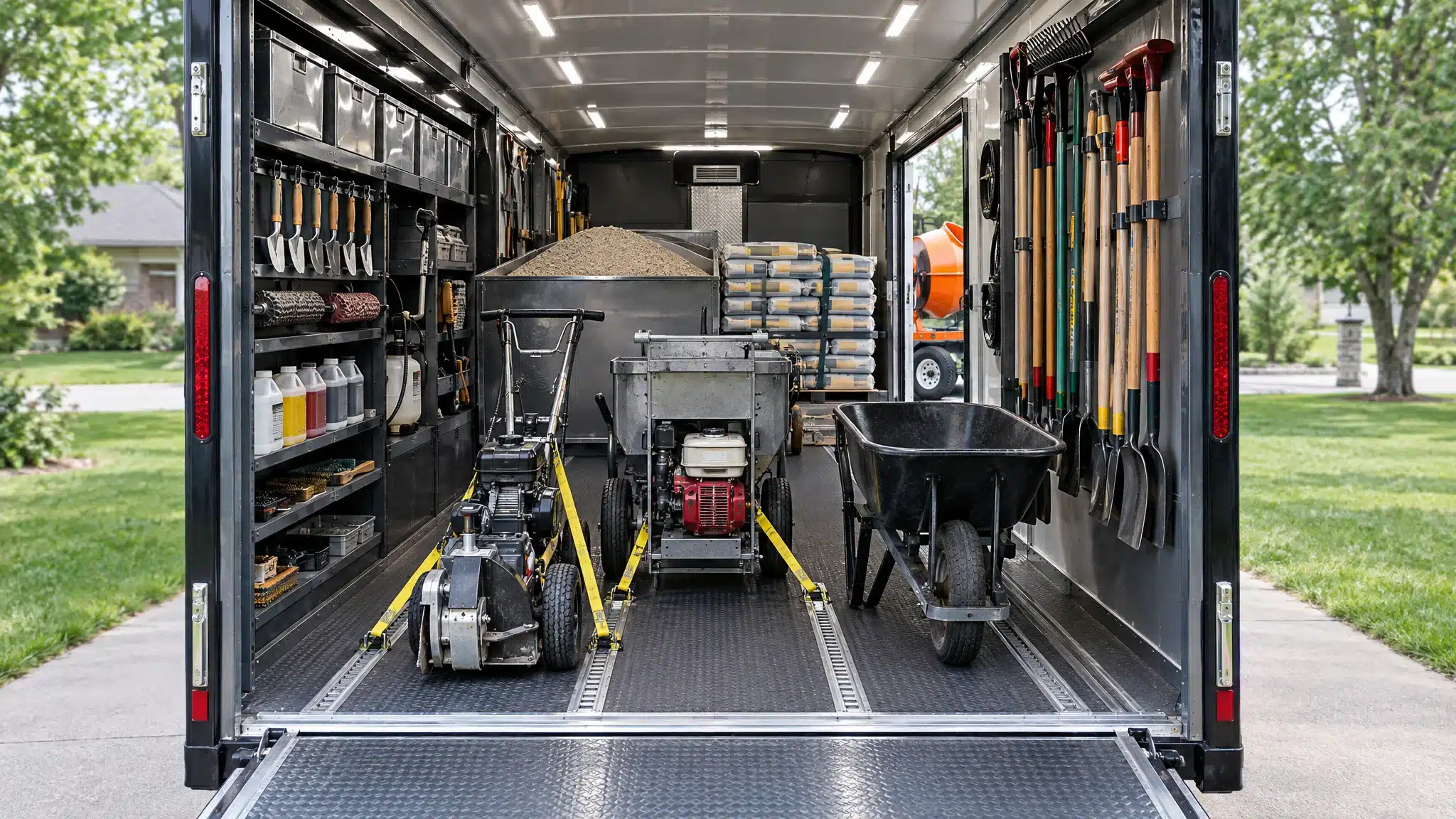
The most common trailer-organization mistake is treating the trailer as general storage instead of a production-flow system. A trailer that is organized around the real sequence of a curbing job, ground preparation, mixing and material supply, extrusion, finishing, and cleanup, keeps your crew moving instead of searching.
- Ground prep: edging, trenching, or sod-cutting equipment should be the first thing accessible, since this work happens before the pour starts.
- Mixing and material supply: the mixer, mix materials, and sand should be positioned for a steady, uninterrupted supply to the hopper.
- Extrusion: the curb machine and its molds need clear access and a stable staging area near the ramp.
- Finishing: trowels, roller stamps, color products, and sealer tools come next in the flow.
- Cleanup: a dedicated spot for cleaning supplies and tools keeps the machine ready for the next job.
Loading and Ramp Access for Heavy Equipment
Curb Depot trailers use a lower deck height and pull-out ramp, which reduces strain while loading and unloading heavy equipment, conserves crew energy, and lowers fall risk. Since the ramp is where your heaviest rolling equipment, curb machines, mixers, and ground-prep units, moves on and off the trailer, those items should be positioned closest to the ramp rather than buried behind lighter gear. This single layout decision can save real time at the start and end of every job.Before loading equipment for transport, remember that federal cargo-securement rules require equipment to be secured against shifting and falling using rated, serviceable securement components appropriate to the load and vehicle.
Keep the Mixer Where the Crew Can Use It
A production-stopping mistake is leaving the mixer back at the shop. Curb Depot’s trailer mixer-mount option keeps the mixer with the trailer so it is available at every job, rather than becoming a separate item a crew can forget. Pairing this with a dedicated material supply area supports the goal of a consistently supplied mixing workflow, which is one of the biggest factors in avoiding mid-job slowdowns.Mix consistency matters as much as mix availability. A mix that is too wet can slump after extrusion, while a mix that is too stiff or dry can stall the plunger, leave profile voids, or cause crumbling. Organizing the mixing area so the operator can batch consistently, without stepping around other equipment, directly supports better curb quality and fewer stoppages. An empty hopper is just as costly: running out mid-pour can create gaps or weak spots, which makes close coordination between mixing, loading, and machine operation a production issue rather than a minor inconvenience. For more detail on avoiding these interruptions, see how to reduce downtime on landscape curbing jobs.
Protect Tools, Molds, and Materials
Not everything on the trailer should live in the high-traffic loading and production area. Curb Depot trailers include weatherproof door seals and tight locks, which support separating protected storage for tools and equipment from the areas your crew moves through constantly during a pour.
- Store molds, trowels, roller stamps, and color products together in a protected, accessible section so profile changes do not require a trailer-wide search.
- Give backup wear parts a dedicated home alongside inspection and cleaning supplies, so pre-job checks do not get skipped for lack of a convenient spot.
- Keep sand and mix materials accounted for in your layout. Curb Depot trailers offer up to 4 cubic yards of sand capacity, so material volume should be planned alongside machine and tool storage, not as an afterthought.
If your crew changes curb profiles during a job, protected mold storage becomes even more important. The Harpten machine uses a bolt-free quick-release mold system, with mold changes reported around 10 seconds, but that speed only pays off if the right mold and its matching trowel are easy to find.
Build Daily Checks Into the Layout
Trailer organization also supports machine reliability. Rushed ground preparation, inconsistent low-slump mix, an empty hopper, and skipped pre-job machine checks are common causes of production stoppages. Giving pre-start inspection items, engine oil, belt tension, and the mold and plunger assembly, a deliberate, accessible spot on the trailer makes it easier for a crew to run these checks before every job instead of skipping them under time pressure. Cleaning hardened concrete from the machine after use, with cleaning supplies stored nearby, helps keep equipment ready for the next start.
Planning Trailer Size and Capacity
Trailer length alone does not determine whether a layout will work. When deciding between an 18-foot and 23-foot trailer, or a custom size, consider the full equipment picture:
| Factor | Why It Matters |
|---|---|
| Ramp access | Heavy rolling equipment needs a direct path to and from the ramp |
| Mixer and mount | A mounted mixer needs dedicated space that stays with the trailer |
| Ground-prep equipment | Edgers or sod cutters need to be staged for first use on the job |
| Curb machine | Needs clear staging near extrusion work and mold storage |
| Protected tool storage | Molds, trowels, finishing tools, and parts need a secure, separate area |
| Material capacity | Sand and mix material volume should match job demands, not just machine needs |
The Business Pro Curbing Package illustrates how this comes together in practice, pairing a 23-foot trailer with a Harpten curb machine, mixer and trailer mount, bed edger or sod cutter, wheelbarrow, molds, matching trowels, roller stamps, finishing tools, color products, cable, and a sealer sprayer. Viewing these as workflow zones, rather than a pile of individual purchases, is what makes a trailer setup genuinely productive. Explore a complete curbing equipment setup or see Curb Depot’s curbing trailer options built for jobsite readiness to compare sizing and features.
Frequently Asked Questions
How do I choose between an 18-foot and 23-foot curbing trailer?
Base the decision on how much equipment and material your operation needs to transport together, including the curb machine, mixer, ground-prep equipment, protected tool storage, and sand or mix capacity. Custom sizing is also available for operations with specific layout needs.
What equipment should be easiest to unload first at a landscape curbing job?
Ground-prep equipment should be positioned for first access since that work happens before mixing and extrusion begin, followed by the curb machine and mixer staged near the ramp for efficient loading and unloading.
How can trailer organization help prevent curb machine downtime?
Keeping pre-start inspection items, backup parts, and cleaning supplies in a dedicated, accessible spot makes it easier for crews to complete checks before every job, which helps catch issues before they turn into mid-pour stoppages. Organized mold and material storage also keeps the mixing and extrusion workflow steady.
Get Your Trailer Set Up Right
A well organized curbing trailer keeps your crew moving from ground prep through cleanup, with less time lost to searching for tools or managing avoidable stoppages. Curb Depot supports curbing businesses throughout Appleton, WI, Neenah, WI, Menasha, WI, Kaukauna, WI, and the greater Fox Valley, WI area with trailers, equipment, and complete packages built around real jobsite workflow. Call (920) 740-2218 to talk through trailer sizing and equipment options for your operation.
Earn More With Natural Stone.

Click to Register

Create beautiful curb with unique stamps.

Looking to sell your equipment?
Let us help.









Ready to Order Your New Curbing Trailer? Request More Info.
Give us a call at (920) 740-2218 or simply fill out the form below to learn more about getting all the tools and training to get started. We make the process easy to start earning money in landscape curbing.