
Start With Your Full Daily Load, Not Just Trailer Length
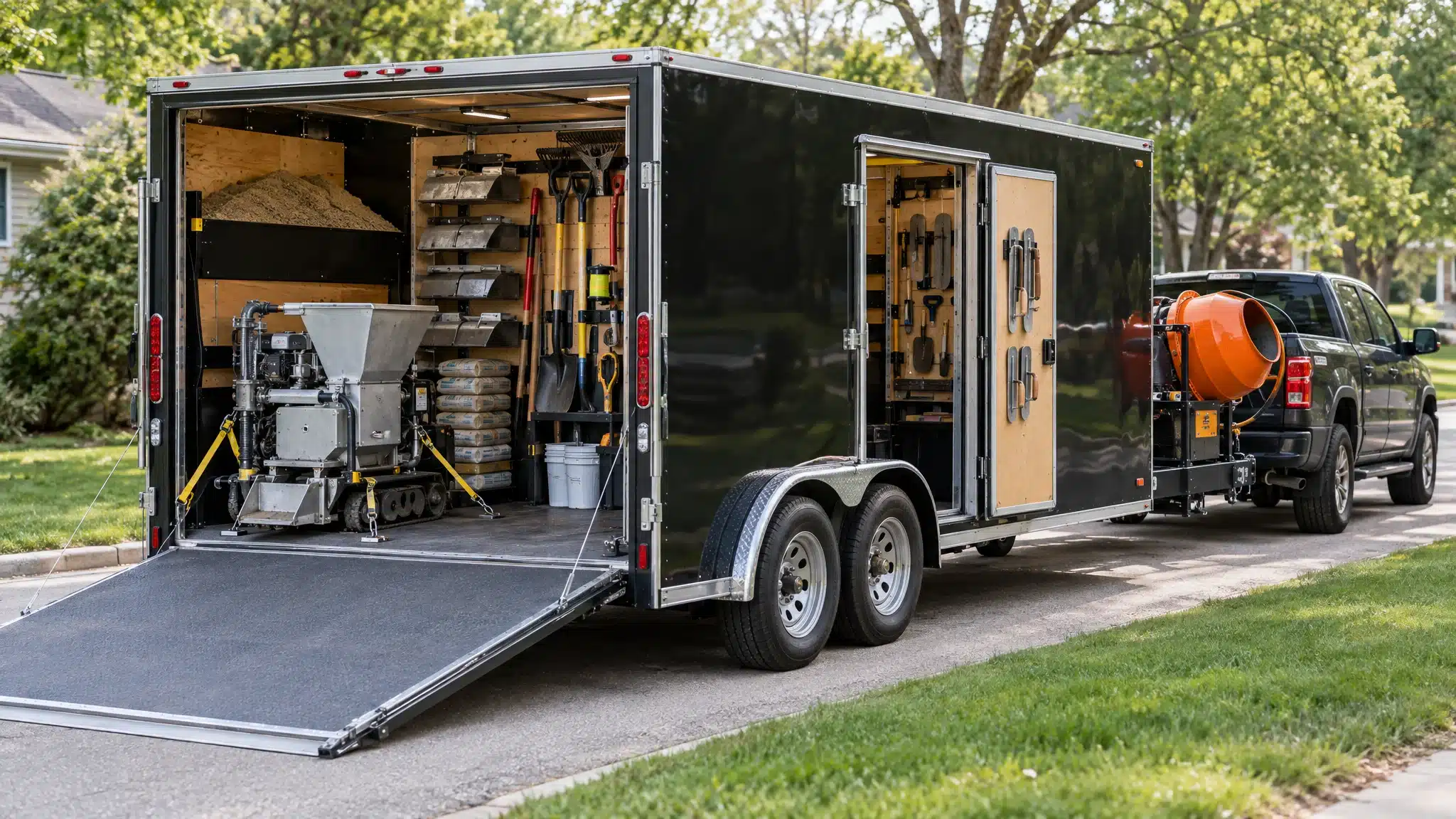
Before comparing trailer sizes, list everything that needs to ride along on a normal job: the curb machine, the mixer, sand, cement, molds, trowels, hand tools, and any stored materials for the week. Purpose-built curbing trailers in the industry are generally sold around defined gross weight ratings, sand capacity, and configured equipment loads, so it is worth requesting and confirming the exact specifications for the trailer and configuration you are considering rather than assuming capacity based on size alone.A longer trailer is not automatically the right call. A larger trailer can add material capacity and storage, but it can also change towing, maneuvering, parking, and crew workflow. The more useful comparison is what must be carried and accessed on a typical job, and whether the layout actually supports that work.
Loading Access Deserves the Same Attention as Storage Space
Curbing crews load and unload heavy equipment multiple times a day, so access matters as much as capacity. Curb Depot trailers are built with a lower deck height and a pull-out ramp designed to reduce strain during loading and unloading, and to help protect crew members and equipment from falls. Repeated loading and unloading is an operational safety concern, not just a convenience feature, so it is worth walking through how your crew will actually load the machine, mixer, and materials before settling on a layout.Mixer placement is part of that same decision. Curb Depot offers a mixer-mounting system that allows the mixer to be mounted directly to the trailer, which keeps it in a dedicated, always-ready position instead of being loaded and unloaded separately on every job.
Protecting Equipment and Materials in Transit
Weatherproof door seals and tight locks on Curb Depot trailers help protect stored tools and materials from the elements and from the road. Capacity matters here too: the 23-foot Business Pro trailer carries up to 4 cubic yards of sand, which is a useful reference point when you are sizing storage against a week’s worth of material rather than a single job.
Comparing the 18-Foot and 23-Foot Options
Curb Depot offers 18-foot and 23-foot curbing trailers, with custom sizing available on request. The trailer size is tied to the equipment package it ships with, so the decision is really about expected operating scope rather than length by itself.
| Trailer Size | Paired Package | Notable Feature |
|---|---|---|
| 18-foot | Business Package | Lower deck height and pull-out ramp for everyday loading |
| 23-foot | Business Pro Package | 4-cubic-yard sand capacity and mixer-mounting setup |
See the full available curbing trailer sizes and features for current specifications, or ask about a custom size if your setup falls outside these two options.
What Comes With the Trailer
Curb Depot’s Business and Business Pro packages pair the trailer with a Harpten curb machine, a concrete mixer, ground-prep equipment, molds, trowels, training, and selected materials or accessories. That is worth factoring in before you buy a trailer on its own, since the trailer is really one piece of a larger operating setup. Review the complete curbing equipment packages to see how the trailer fits with the rest of the equipment, or look at the fully equipped curbing business setup built around the 23-foot trailer.
- Harpten curb machine
- Concrete mixer (with optional trailer mounting)
- Ground-prep equipment
- Molds and trowels
- Training
- Selected materials and accessories
Before You Order: What to Verify
Curb Depot trailers are manufactured in the United States and include a 5-year warranty. Free color matching and smooth black sides are available for contractors who want the trailer to carry their logo and branding on the jobsite. Because custom sizing is available, it is worth confirming the final configured specifications, load capacity, included equipment, and current pricing directly with Curb Depot before you order, especially if you are considering a size or configuration outside the standard 18-foot and 23-foot options.
Frequently Asked Questions
Is an 18-foot or 23-foot curbing trailer better for a new business?
It depends on the equipment package and daily load. The 18-foot trailer pairs with the Business Package, while the 23-foot trailer pairs with the Business Pro Package and its larger sand capacity. Match the size to the equipment and materials you plan to carry rather than choosing length first.
What equipment should fit on a landscape curbing trailer?
At minimum, plan for the curb machine, a mixer, sand, cement, molds, trowels, and hand tools. Curb Depot’s Business and Business Pro packages bundle these with ground-prep equipment and training, which is a useful starting checklist when sizing a trailer.
What trailer specifications should I verify before ordering a custom setup?
Confirm the load capacity, sand capacity, ramp and deck configuration, included equipment, warranty terms, and current pricing for your specific configuration, since custom sizing is available on request.
Talk to Curb Depot About Your Trailer Setup
If you are weighing an 18-foot setup against a 23-foot Business Pro configuration, or you need a custom size for your operation, call Curb Depot at (920) 740-2218 to go over your equipment list and find the right fit. Curb Depot is based in Appleton, Wisconsin and works with curbing professionals and business owners across the Fox Valley area and beyond.
Earn More With Natural Stone.

Click to Register

Create beautiful curb with unique stamps.

Looking to sell your equipment?
Let us help.





Ready to Order Your New Curbing Trailer? Request More Info.
Give us a call at (920) 740-2218 or simply fill out the form below to learn more about getting all the tools and training to get started. We make the process easy to start earning money in landscape curbing.